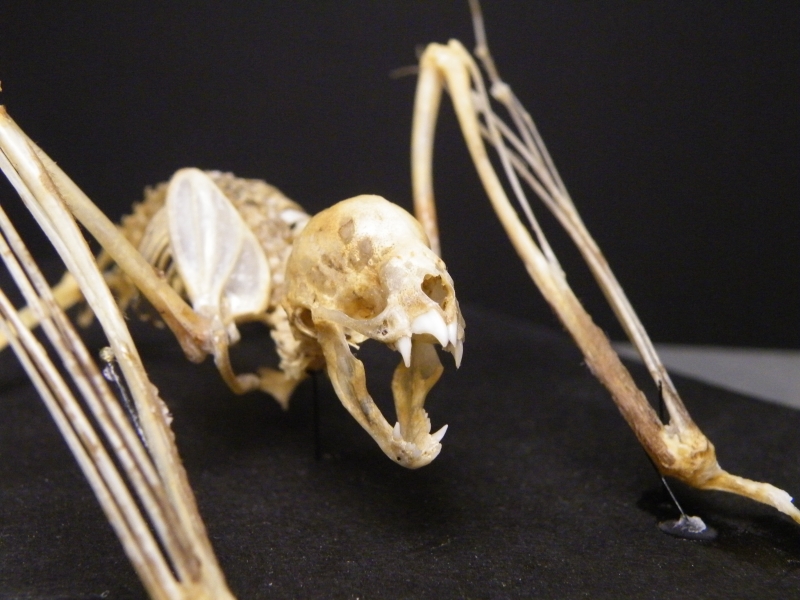
This rant was prompted by a very dear friend who enjoys romance novels. Specifically paranormal ones. I have nothing against that. Read whatever you want to read. What I have an issue with is the moment in the book after the vampire bites his lover, where he licks the wound closed because their saliva is supposed to have amazing healing properties.
I understand that this is a very specific issue to have with vampires in books. But I want to keep this post away from the normal "I hate Twilight" nonsense. Dracula was the only vampire story for me, and that's the way it will always be. I never even picked up another vampire book. So I'm staying away from that potentially disastrous conversation. Frankly I'm amazed people still talk about Twilight, if it was so horrible.
Anyway, back to my problem. The licking to seal the wound closed. Vampire bat saliva has anticoagulants in it to prolong bleeding. Not to heal wounds. I think all these authors wanted to pretend their vampires were more like other mammals in the sense that wound licking can have some healing properties. Everybody has heard stories about some dog licking a wound, and it helps to heal, or whatever. That's true, wound licking does sometimes help, through cleaning or whatever. It also sometimes introduces bad oral bacteria into your system and can kill you.
In this case, the authors made their vampires more like this:
Extinction is natural. Healthy even. You can learn/research all about it. It's called background extinction. That being said, extinction rates have shot up in modern times, increasing exponentially since the industrial revolution. I am definitely not that smart, but even I can see the connections. This is bad. Even with our propensity to ruin habitats, we should be more careful about what species we destroy, especially in the tropics, because that biodiversity provides a lot of our medical resources. So if you're too selfish to help animals and plants out of the kindness of your heart, do it for your health. We get drugs from those things.
That being said, I'm also of the opinion that we should appreciate some of the things we never had to compete with. Like Dunkleosteus.
Dunkleosteus is a prehistoric member of the extinct class Placodermi. Placodermi means plate skinned, and you'll see why.
This is what Dunkleosteus looked like:
Would you go swimming in the ocean if you knew that thing was down there somewhere? No. That thing is terrifying. The force of that bite would be around 8000lbs/square inch [right in league with T-rex]. It was over 30 feet long and found in shallow seas, right where you'd want to swim.
Dunkleosteus made a guest appearance in Dinotopia, for those of us who can't contain our nerdiness [It is an awesome book, I hope all of you have]. The Fish that guarded the Diamond cave, which was the entrance to the World Beneath, was a dunkleosteus [and please don't judge me for not even having to look that up]. It attacked the Remora.
A lot of extinct species are being revived in awful movies, like Megalodon. This giant shark was made to look truly ridiculous in Mega Shark versus Giant Octopus and Mega Shark versus Crocosaurus. Painful. The shark wouldn't have had the brain capacity to realize it should be embarrassed, so I will have to be embarrassed for it.
Moral of this, if you're going to revive extinct species in the entertainment business, do it like Dinotopia, not like Mega Shark. You will turn an impressive predator into a laughing stock.
I was watching Finding Nemo with several small children, and I was finding it a bit more interesting since I've now taken a Marine Biology class, and I'm currently enrolled in a class called Sharks. It is an awesome class, and I'm enjoying it a great deal. Then we got to the part where Marlin (the daddy Clown Fish) meets Bruce (the Great White Shark), Anchor (the Hammerhead Shark), and Chum (the Mako Shark). This part was fine for everyone else, but I discovered something. Bruce, who was undoubtedly intended to be a male shark, is, in fact, female.
Male cartilaginous fishes have claspers, sort of modified reproductive fins, formed from the posterior part of their pelvic fins.
Compare:
Bruce
To a real Great White Shark
The animators probably thought that was too obscene, or something ridiculous, and didn't want kids asking about it. But if my sharks class ruined Finding Nemo for me, I'm going to ruin it for everybody else.
It's related to animals, I promise. Not that Willem Dafoe isn't completely awesome, but this just makes him even more so. Dafoe is in a movie I am just now hearing about. It came out a while ago in Australia. It's called "The Hunter," and it's about thylacines. For those of you who appreciate the vernacular, the Tasmanian Tiger.
I have not seen this movie. I am excited for a couple reasons. First, it has Willem Dafoe in it. Second, it's about thylacines, and not enough people in the world know about thylacines. I am worried for only one reason. I don't know if they get all the information right. This is a huge problem in the movie industry, they will bend facts to fit their plot, and won't care about the rest of it, or they'll take one example and act like that is the norm for the species.
On that note, let's discuss the thylacine so that everyone knows what's what.
Thylacinus cynocephalus is extinct. People may not think so, but everyone is pretty sure they are, which is a huge disappointment. There are sightings all the time, but no confirmations. I find this to be a horrible loss. Thylacines are probably one of the most awesome mammals this earth has produced. These things are so cool, Chuck Norris pales in comparison.
Thylacines are carnivorous marsupials. Historically they occupied Tasmania, Australia, and Papua New Guinea, and were quite wide spread. They are roughly the size of an adult German Shepard dog, but the limb-length ratio is different. Dogs have long legs in proportion to their trunk [spinal column minus tail], thylacine legs are shorter, suggesting that they stalk their prey. They have yellow-brown or grey-brown fur, with 15-20 black/dark brow stripes from the back of the shoulder blades to just before the tail. The tail itself is not abruptly separated from the body, but tapers, like the tail of a kangaroo. They have 46 teeth adapted for slicing and crushing. They could open their jaw ridiculously wide, lowering their bottom jaw to an angle of (SOME SAY) almost 180 degrees. This, however, would be anatomically impossible for them to do without dislocating the mandible.
The female marsupial had a back-opening pouch, unlike other marsupials, namely the kangaroo, who has a front-opening pouch. Estimated life span in the wild is 8-12 years. They can jump 6-8 feet. Their preferred habitat is unknown, as well as their hunting methods and preferred prey. Blood samples suggest that they are closely related to dasyurids [read: Tasmanian Devil, but other things too].
Please look up more about the thylacine, the more you read, the more you'll be pissed that they're extinct and we can't go to a zoo and look at them, or tag one and see if they actually do hunt in packs.
You can do more research on your own, there's about a million websites for the thylacine. Here's a list of papers written about them, too:
ABC Video (1994). Clash of The Carnivores. Natural History Unit.
Guiler, E. (1985). Thylacine: The Tragedy of The Tasmanian Tiger. Oxford Uni. Press.
Guiler, E. & Godard, P. (1998). Tasmanian Tiger: A lesson to be learnt. Abrolhos Publishing.
Park, A. (1986). A Tasmanian Tiger Extinct or Merely Elusive. Aust Geographic. Vol. 1 No 3.
Smith, S. J. (1980). The Tasmanian Tiger. NPWS, Tas.