Showing posts with label Extinction. Show all posts

21.9.14

Apocalypse Then

We live in the Milky Way Galaxy. Our neighbor is the Andromeda Galaxy. The Milky Way will be consumed by the Andromeda Galaxy in about five billion years (according to the latest studies).

Not to worry, however, because life on Earth will end much sooner than that, when our sun enters the red-giant stage of it's life, it's diameter will reach Earth (having engulfed Mercury and Venus). In all honesty life would probably end before this phase. The sun will become a red giant star in approximately five billion years (about when our galaxy starts getting consumed by Andromeda). However Earth will have gotten too hot for life to continue a bit earlier than five billion years from now.

More heat means more water vapor and less carbon dioxide, so the plants will go first. As plant species go extinct, the animals will decline too pretty much simultaneously. In approximately 2.8 billion years scientists estimate that only the hardiest of microbes will be left behind. Once temperatures reach over 140 degrees Celsius, DNA breaks down, and even those microbes will be lost.

Image courtesy SDO/NASA

Don't fret, however. This is an unimaginably long time away.

Or, perhaps, fret a lot, because current rates of climate change weren't given a lot of consideration, and that's looking bleaker by the second.

Sources.
Milky Way Will Be Consumed

Biosignature Doomsday


15.9.14

Out Of Africa

Recently I went to see the new exhibit at California Academy of Science(CAS), called Skulls. This exhibit is, obviously, about skulls, more specifically, the skulls of vertebrate animals.

It was a wonderful exhibit, and I enjoyed myself very much. I encourage you all to go if you live nearby. My opinion was that the only thing they could so better would be to include more about comparative anatomy, but I'll post about that later.

After I saw this exhibit I went to the African exhibit, which was very interesting, and included a bit about human origins. Now I'm not criticizing this exhibit for the content it included, that was presented beautifully, I'm miffed about what the exhibit didn't include, which was some of the other models about human evolution.

CAS included only the Out of Africa model, which admittedly has the most support right now, but is in no way proven to the point that it is a theory and not a hypothesis.

So I'm going to go over the major hypotheses of human origins, so that you readers may know the options.

The Multiregional Continuity Model
Says: "After Homo erectus left Africa and dispersed into other portions of the Old World, regional populations slowly evolved into modern humans"
Means: Modern humans evolved from their ancestors (that lived all over Africa, Europe, and Asia) all together (albeit slowly) in every location
Looks Like This:
(thanks to Fred the Oyster for the graph)

The Out Of Africa Model
Says: "Modern humans evolved in Africa, migrated out of Africa, and replaced all populations which had descended from Homo erectus"
Means: Modern humans evolved in one location, and the earlier species were outmatched by how super duper awesome modern humans were... I kid... sort of
Looks Like This:

Apologies for poor image quality, and thanks to discover magazine


Now to be sure, Out Of Africa has the most support, but more recent discoveries have challenged it a bit. The timing of human dispersal is controversial, and likely will remain controversial until we discover more fossils, so I'm not going to weigh in on either theory as being more likely than the other. I simply think that both should be considered, and there is nothing wrong with presenting two opinions to the public, or admitting that science has yet to uncover all of the facts.

Sources:
actionbioscience

The Petralona Man

We were all Africans

Genetic Support for the out-of-Africa theory

24.2.12

For the love of all things slimy

Amphibians.

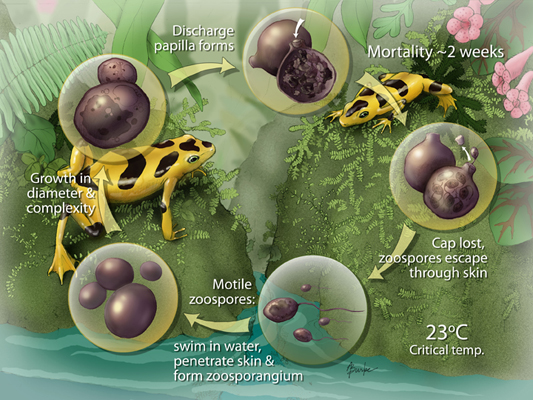
For a while now, I've been working/studying with a lab that researched a certain type chytrid fungus.  It's a herpetology lab (herpetology: the study of reptiles and amphibians, no one knows why they were lumped together, but they were), and the lab focuses on Bd.  That is going to change soon, as I am going to begin studying birds, but I'd like to share a little bit of information I've picked up at my current place of work.

In the vernacular, chytrid fungus is a very old type of fungus, and the species were thought to either be saprobes (they eat dead/decaying stuff) or parasites that live on plants and invertebrate animals.  Recently, however, and when I say recent I mean 1999, which in the world of science is very recent, a species was discovered that infected the skin of amphibians.  Batrachochytrium dendrobatidis (shortened to Bd) was unusual because it was the only chytrid known that affected vertebrates, amphibians specifically.


This is important because Bd appears to be capable of infecting almost all of the worlds amphibian species. An infection with a large amount of Bd is called chytridiomycosis.  This disease causes the skin to become very thick, usually deadly in amphibians because they drink and absorb salts(electrolytes) through their skin, not their mouth.  Abnormal levels of electrolytes can cause heart failure.  In the lungless salamander, which uses its skin to breathe, chytridiomycosis can cause suffocation.


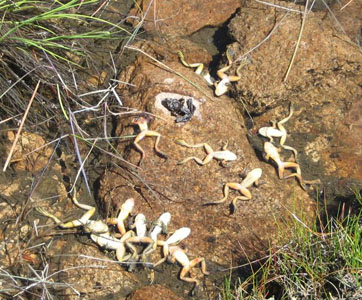
Since it was discovered, Bd has been found on every continent inhabited by amphibians in both wild and captive species.  So far, there is still debate over whether this has been historically present and infecting populations all along and recent environmental changes caused a spike in the disease, or because it was only recently introduced to populations which have no defense.    


This is a serious disease and has contributed to the recent global decline of amphibian populations.  Other factors include environmental change and pollution, and habitat destruction (always a huge and horrible factor, so we need to work on saving the rain forest!). 


Japanese Giant Salamander


Amphibians are critically important to our knowledge of the world around us.  They are the best indicator species.  An indicator species is a species whose presence/absence/health gives an indication of the health of the ecosystem as a whole.  Amphibians are excellent indicators because not only to they live on land and in the water, they also absorb the environment right into their skin: water, salts, toxins, everything in the ecosystem.  


Right now, their decline is telling us something very important.  Habitats and ecosystems are critically changing.  In the United States alone since just 1980, the number of native species suffering in severe population decline has doubled.  The current extinction rate of amphibians is calculated to be at least 200 times the normal rate of background extinction.


Amphibians require a plentiful supply of fresh water free from chemicals and microbes to survive.  So do humans.  Human population growth and climate change are combining to create a situation in which a large and increasing proportion of the human population is denied access to sufficient, clean water. The rapid decline of the world's amphibians is a warning that this most precious of natural resources is under serious threat.  Frogs aren't the ones contaminating said resources with chemicals.  We are.  


We need to wake up and get our shit together. 


Sources: 
Gagliardo, R., P.Crump , E. Griffith,et al. 2008. The principles of rapid response for amphibian conservation using the programmes in Panama as an example, International Zoo Yearbook 42: 125-135.


Hyatt, A.D., DG Boyle, Olsen V et al. 2007. Diagnostic assays and sampling protocols for the detection of Batrachochytrium dendrobatidis, Diseases of Aquatic Organisms 73: 175–192.


Murray, K.A., L.F. Skerratt, R. Speare, and H. McCallum. 2009. Impact and dynamics of disease in species threatened by the amphibian chytrid fungus, Batrachochytrium dendrobatidis. Conservation Biology:23:1242-52.


Rachowicz, L.J., J. Hero, R.A. Alford, J.W. Taylor, J.A.T. Morgan, V.T. Vrendenberg, J.P. Collins, & C.J. Briggs. 2005. The novel and endemic pathogen hypotheses: Competing explanations for the origin of emerging infectious diseases of wildlife. Conservation Biology 19: 1441-1448.


Skerratt, L.F., L. Berger, R. Speare, S. Cashins, K.R. Mcdonald, A. Phillott, H.Hines, and N. Kenyon. 2007. Spread of chytridiomycosis has caused the rapid global decline and extinction of frogs. EcoHealth 4:125-134.